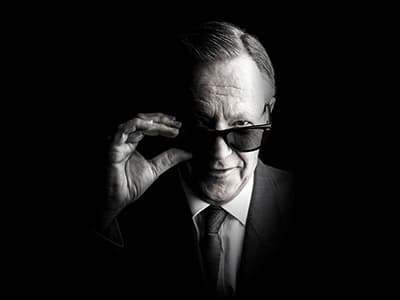
 Left – Zoe Carides and Michael Whalley. Cover – Zoe Carides. Photos – Patrick Boland
I well remember Zoe Carides from GP. It was a decent drama, insofar as it went, but a very modest examination of the abilities of the actor. Tarantula estimates them much better. Suffice to say they are considerable and, happily, matched by her co-star, Michael Whalley, in Alana Valentine's play, directed by Nastassja Djalog. Its format, if you will, is hardly innovative: a play within a play. But, as Ella sang, 'it's not what you do, it's the way that you do it!'
'Desire is a tarantula that bites; and not only the young. Desire is a venom, that courses through the veins long past the days of its ability to be satisfied.' So said Lola Montez. Or, at least, so says Lola in this play, all about the life and longings of the Irish dancer and actress, born Eliza Rosanna Gilbert, but who chose to pretend she was a Spanish dancer, but who was probably best known as the mistress of King Ludwig, of Bavaria, who made her a countess. For my money, one of her most attractive features was her leaning towards the liberal and she made good use of her position to influence reform along those lines. But the so-called March revolution, of 1848, which was, ironically, a popular push which leant in the same direction as Lola, forced her out of Germany and by-and-by, long story short, she came to Australia, for a time. In fact, she came with and for the gold rush, reviving her career to entertain miners.
Montez became the victim, or beneficiary, of idle gossip (scandalously legitimised by, of all people, an historian), which had it that, in performing her infamous spider dance at Melbourne's Theatre Royal, she raised her skirt so high it was plain to see she wore not a stitch underneath. Montez was the Madonna of her day, learning how to turn ill-repute to profit. And like Ms Ciccone, she was no shrinking violet. Far from favouring a less than complimentary review with equanimity, she set upon the editor with a whip! (I thank my lucky stars that, to date at least, I've only endured verbal flagellation). This and other bizarre, stranger-than-fiction scenes are played out. And, of course, Lola has possibly had even more of a life in fiction, than the one she lived and breathed.
Valentine's play takes her legend one step further. Carides is Lola. Well, no. Gina, actually. Gina is the principal and, it appears producer-director (and possibly writer as well), of a play about Lola. She has engaged Terry, a younger actor, to play Lola's lover, Noel Follard, who vanished from a ship they boarded for California. The mystery of his disappearance gave rise to rampant speculation. Did he jump? Was he pushed?
Lola's life was, it seems, live theatre in itself, which has afforded Valentine plenty of material. Carides surpasses herself. Which, given her performances in recent years, is saying something. She is almost incandescent as Montez, ruffling her skirt seductively while engaged in one of Valentine's arachnid monologues. She sings, too. I'd no idea she has such a lovely, refined voice, other than the comely, husky one she uses to speak. It's an impeccably judged performance that cements her status, in my mind, as one of our best-ever actors, alongside the likes of Blanchett and Nevin, to name but two. She has become seasoned and is at the very peak of her powers. As an aside, Beth Allen's gown adorns her beautifully and sets her up evocatively as a thoroughly credible Lola.
Michael Whalley boasts nuance beyond his years and his being cast proves an inspired decision. He also carries a tune well. There's a chemistry between the actors that works on three levels: firstly, between Folland and Montez; secondly, between Terry and Gina; finally, between Whalley and Carides. But while the sexual tension between younger male and older female is palpable, Valentine is, perhaps, as much interested in Montez as feminist fatale, if you will, as femme fatale, though at no stage does any agenda insinuate itself. She seems to see Montez holistically, as an all-round role model, transcending the boundaries, real and imagined, of her time. She uses Gina to bring this into stark relief: Gina is someone living at a later time, endowed with far more actual and notional freedoms than the women of Lola's times, but hemmed-in by her own hangups, rules and habits.
Djalog has collaborated sympathetically, so that the entire subject of desire is dealt with sensitively and authentically, which means recognising its refusal to conform to social mores; it just is and has an unstoppable momentum all its own, oblivious to temporal or other constraints. As colourful and intrinsically interesting as they are, Montez and Folland, Gina and Terry (Whalley and Carides slide between these characters with such fluidity, it's hard to believe we're watching the same actors play both sets of star-crossed lovers), are really, in the end, mere vehicles for this broader treatment. In this way, Tarantula proves a work of immense maturity and sophistication; which is to say, the characters can easily sustain themselves on their own, but also becomes vessels through which a universal expeirence can be meaningfully and movingly discussed.
And, what with the imminence of the Melbourne Cup, there's at least one scene that's bound to whip you into something of a fevered frenzy.
The tarantula, like all fit-and-well spiders, has eight legs. I hope this play has nine lives. It deserves them.
Tredwood Productions by Special Arrangement with RGM Artist Group presents
Tarantula
by Alana Valentine
Director Nastassja Djalog
Venue: King Street Theatre, 644 King Street, Newtown
Dates: 10 Oct to 3 Nov, 2012
Times: Tues-Sat 7.30PM (duration: 90 mins, no interval)
Tickets: $32/$24 (Preview $24). (Groups 10+ $25)
Bookings: www.trybooking.com/BXGM | 1300 306 776